Aesthetics
Discover how school's Aesthetics Department builds creative and critical thinking skills through Art, Music, and more.
Aesthetics Department
Our Philosophy
To engage students in diverse processes of artistic creation, expanding their aesthetic experiences, and enriching their lives as future leaders, scholars and gentlemen.
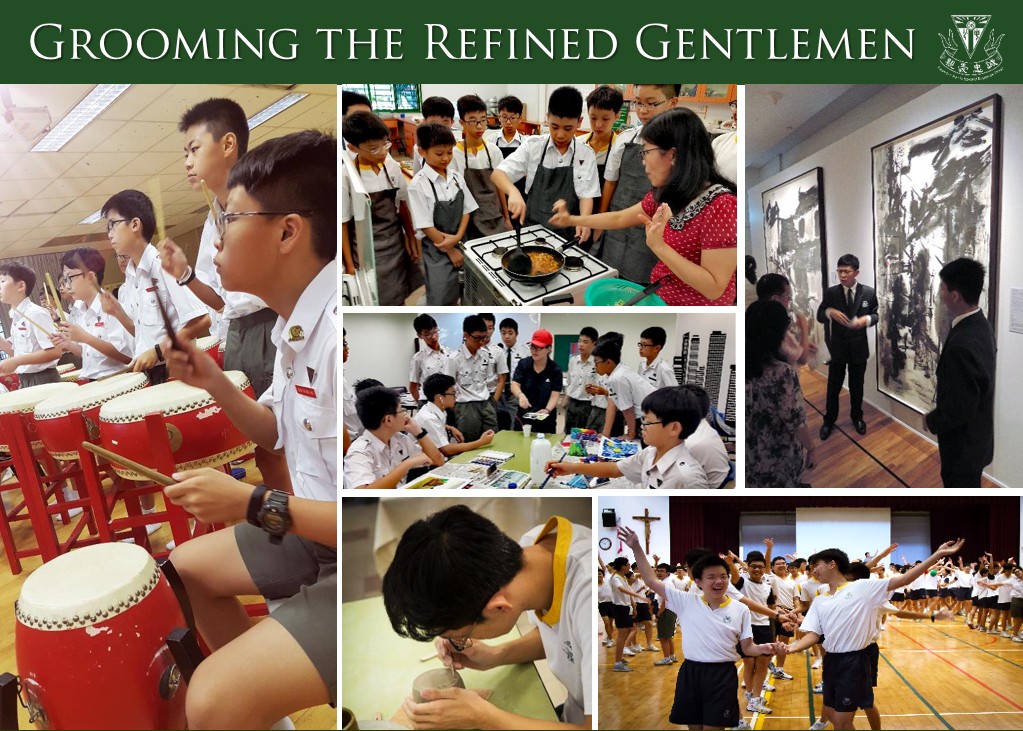
Grooming the refined Gentlemen
Our Approach
Engaging our students in diverse processes of artistic creation both individually and in groups, the Aesthetics programme of Catholic High School aims to groom them as our future leaders to serve society as gracious and refined gentlemen in their various fields of pursuit.
Comprising Art, Design & Technology, Food and Consumer Education and Music, the Aesthetic programme develops critical and creative thinking skills through expressions in art and music, design awareness and appreciation, and in making informed food and consumer choices. Focusing on experiential learning, the Aesthetics programme enhances the students’ 21st century competencies of self-awareness, self-management, responsible decision-making, social awareness and relationship management. The sense of the aesthetics developed in the learning process will also prepare our students to lead a balanced life and quality lifestyle, preparing our future leaders to serve society as gracious and refined men in their various future fields of pursuit.
Aesthetics Modules
Aesthetics Modules | Year 1 | Year 2 |
|---|---|---|
Art, Design and Technology | – Elements and Principles of Art and Design | – Creative Exploration in 3D Media |
General Music | – Elements of Music | – Instrument: Guitar |
Food and Consumer Education | – Food and Nutrition |
Signature Programmes
MEP@CHS offers a comprehensive music programme for students with the aptitude and passion for music. Find out more about MEP@CHS.
One of the signature programmes in our Aesthetics programme is Rapid Prototyping with 3D printers under Design and Technology class. In this programme, students use a 3D design software and work with rapid prototyping and fabrication tools, i.e. the 3-D printing machine, to experiment and realize their designs. Students will be able to improve their abstract designs by looking at the prototypes and refine their designs towards a final product. This process of integrating technology with rapid prototyping skills aims to nurture our students towards a community of makers.